

How To Set Up A Fly Rod
Fly Rod Set Upwards
Fly Line-fishing is a great stress release, it will take y'all to some far away remote scenic wonderlands that perhaps you would otherwise never venture to. It's challenging, there's e'er something new to acquire, a new river to visit, a new friend to meet, so step on board and enjoy the ride.Beneath is what you lot need to go started and your bones Fly Rod ready;
Fly Rods;
The fly rod is what allows us to cast the fly line and also works as a daze absorber equally we play a fish (with fly line-fishing you can't merely wind them in, the line is also light, you need to play the fish to tire it before landing it)
Wing rods come with a weight rating. Weight #5 to #8 comprehend most of our fly line-fishing situations. As a general guide a #6 weight wing rod is a good general all round rod for streams, small to medium size rivers and lake edges. A #7 is expert for windy days in places you would use a #six normally and for bigger rivers and lakes while the #8 is a large river and lake rod, an #8 is a popular weight for fishing the Tongariro river. The #5 is more than for the experts who already know how to cast well and play fish finer, because they are lighter they are pop with good fishermen.
As yous start out in that location lots of new gear and terminologies to become familiar with;
Fly Rod setup;
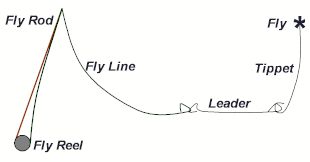
I have a number of very expert fly rod packages to get you lot started that come with the rod, reel, fly line backing fly line, and rod tube to protect your rod from breakage.
Via this link you can detect the various fly fishing knots used to join tippet fabric to leaders, leader to fly lines which you lot'll demand to larn to tie.
How information technology all works together;
The reel simply is a storage place for your fly line, it needs to be well maintained with a smoothen drag organisation so that the line can pull off freely while casting or playing a fish. Onto the reel goes the fly line bankroll followed past the fly line. A beginner should learn to hold their rod in their strongest hand and therefore set the reel up to be wound with their other mitt. Then a right hander holds the rod in the right manus and winds the reel with the left. All the reels I stock are easily converted by changing their central spools for either left or right hand wind.
The fly line is an important part of the fix upward as it provides the weight that allows us to bandage (every bit a spinner does in spin fishing) Fly lines come in certain weights and you should match the weight of the fly line to the rod you are using. Fly lines come in many different combinations for various types of wing line-fishing. But simply there are floating lines that stay on the water surface or sinking lines that will sink to various depths at various speeds. Fly lines come up in different tapers besides which effect how they bandage. A weight frontward taper (WF) is a proficient ane for learning with and too is good for treatment windy atmospheric condition. It'south good advice to purchase the best line you can afford, the ameliorate quality makes a difference, and a good line volition terminal many seasons.
A leader is usually tapered, starting thick at the butt finish and tapering down to a finer indicate. The thicker cease of the leader should exist attached to the end of the fly line. The reason for a tapered leader is that it helps transfer the power of the cast downward the leader which helps the leader to 'role over' and lay out straight on the water.
The leader is attached to the end of the fly line, you can use a nail knot or many use a braided loop. Leaders come in dissimilar lengths and breaking strain, just to become started I suggest a 9 human foot leader with 7lb (lb = pound) breaking strain.
Tippet textile is fine nylon or fluorocarbon angling line and is used to extend the leader, change information technology�southward breaking strain. Either the nylon or fluorocarbon will exercise, the fluorocarbon is more than expensive, but has the advantage of being less visible in the water and sinks faster. 6 or 7lb breaking strain would exist skilful to use when starting out. The Tippet is attached to sparse stop of the leader using the surgeons knot or the claret knot and we tie our fly to the cease of the tippet using a Clinch knot
The Leader and Tippet setup that I use; I use a nine lb leader, ten or 12 feet long and add two ten 50cm lengths of tippet, the first length would exist 8lbs and the 2nd 6lbs, then the fish gets to see the 6lb piece (a 3rd piece could exist 4lbs). And then I step the tippet down which helps the leader straighten. The all of import thinner bit on the end is what the fish sees and this also gives a better the presentation of the wing as the fly lands more delicately and is therefore less likely to spook the fish. So it becomes a balancing act of using fine enough tippet then every bit not to spook your fish but strong enough then that the fish wont break off in one case you practise hook him!
NB If yous tie flies directly onto the leader information technology doesn�t have long to shorten it considerable every bit every fourth dimension you change a wing you end up cutting a bit off, and then the tippet helps the leader to last longer.
The fly selection depends on the blazon of line-fishing you are wanting to practice. The main ii types used on rivers and streams are dry flies (where your fly floats on the surface imitating and natural insect) or nymphs (where your fly sinks below the surface down to the depth of the fish and imitates natural in-stream insect life) A 3rd type is a wet fly which will again imitate nymphs and a quaternary is a lure where the wing imitates a small fish.
Popular dry flies are the Adams Parachute, Kakahi Queen, Dads Favourite, Accident Fly, Cicada and Royal Wolf. Popular nymphs include the Hare and Copper, Pheasant Tail, Hares Ear, Stone Flies, Glo Bugs. With your nymph selections it's useful to accept a selection with and without bead heads. Those without are good in shallow h2o while those with the beads will sink quickly in deeper water and it'due south important to get your nymph down to the level a fish is feeding at. Tungsten beads are heavy than the standard beads.
For lake fishing all of the above can exist effective, only many anglers too fish more with lures such as the Mrs. Simpson, Hamils Killer, and Woolly Buggers being specially popular
A farther guide to fly pick regards size, in very clear water and spooky fish utilise smaller sizes, still it'southward useful to take a range of sizes of each fly and often if i doesn't piece of work, changing size tin can be the difference.
Many flies aren't exact imitations, and don't need to be, presentation of the fly is much more critical every bit to whether a fish will have it or not so;
When casting the goal should be to be able to lay the line, leader and tippet out consistently in a straight line, with the leader and tippet fully extended. And then when yous bandage to a fish in streams and rivers, ideally the fly should state near 2 meters alee of the fish and drift back downward in the current to the fish. If the wing lands very softly on the commencement cast you lot'll have a very good chance of the fish taking your fly.
However if the fly lands heavily or in a heap on pinnacle of the fish or if you cast too long and he see your floating fly line then the warning bells start ringing and the chances of him responding to the fly diminish chop-chop! In fact the response will be a quick film of the tail and a dash to the deepest function of the river. Click here for learning to cast a fly rod
At that place are no ready rules equally to how any one fish will react, some are very hands caught, while others can be incredibly spooky......
Source: https://www.flyshop.co.nz/fly_rod_setup.html
0 Response to "How To Set Up A Fly Rod"
Post a Comment